TL;DR:
- Intent recognition AI interprets user goals to improve chatbot effectiveness and customer satisfaction.
- Approaches vary from rule-based to deep learning, each suited for different business needs.
- Handling edge cases and customizing domain-specific data are critical for deployment success.
Most businesses assume that deploying a chatbot means solving their customer communication problem. In reality, a chatbot without solid intent recognition is little more than an expensive FAQ page. Customers ask questions in unpredictable ways, use industry jargon, and often want multiple things in a single message. Intent recognition AI addresses this gap directly, interpreting what users actually mean rather than just what they literally type. This guide breaks down how intent recognition works, which approaches suit different business needs, and what pitfalls to avoid when deploying these systems in real operational environments.
Table of Contents
- What is intent recognition AI?
- How does intent recognition AI work?
- Approaches to intent recognition: Rule-based, machine learning, and beyond
- Edge cases and challenges in real business settings
- A fresh perspective: Why most businesses get intent recognition wrong
- How SimplyAI can help your business leverage intent recognition
- Frequently asked questions
Key Takeaways
| Point | Details |
|---|---|
| Core definition | Intent recognition AI identifies what a user wants, unlocking smart automation and service improvements. |
| Workflow clarity | The process involves input analysis, feature extraction, classification, and action based on user intent. |
| Approach matters | Choosing between rule-based, machine learning, or deep learning impacts accuracy and adaptability. |
| Edge case handling | Addressing ambiguous or overlapping intents is vital for reliable business AI solutions. |
| Domain adaptation | Tailoring models to industry-specific data dramatically boosts practical intent recognition results. |
What is intent recognition AI?
Intent recognition AI is the technology that enables machines to identify the purpose or goal behind a user’s input. When a customer types “I need help with my order,” the system does not just scan for keywords. It classifies the underlying intent, whether that is tracking a shipment, requesting a refund, or reaching a support agent. This distinction is what separates a genuinely useful AI interaction from a frustrating dead end.
Intent recognition sits at the core of many AI-driven tools businesses already use. It powers building AI chatbots, voice assistants, automated ticketing systems, and CRM workflows. Whenever an AI system needs to decide what a user wants before taking action, intent recognition is doing the heavy lifting behind the scenes.
The technical workflow follows a structured path. Core mechanics include text preprocessing, feature extraction, intent classification using ML/DL models, and confidence scoring to trigger actions or clarifications. In plain terms: the system receives input, cleans and analyzes it, identifies the most likely intent, assigns a confidence level to that prediction, and then either acts or asks for clarification.
Understanding this workflow is not just a technical exercise. For business leaders, it reveals exactly where AI systems can be tuned, where they are likely to fail, and how to design interactions that deliver consistent, measurable results.
Common outputs from a well-configured intent recognition system include:
- Answering customer queries automatically without human intervention
- Triggering backend tasks such as order lookups or appointment bookings
- Routing conversations to the right department or agent
- Escalating issues when confidence scores fall below acceptable thresholds
- Generating personalized responses based on classified intent and user context
For decision-makers, the practical takeaway is straightforward. Intent recognition is not a feature you bolt onto an existing system. It is the foundational layer that determines whether your AI investment actually improves customer experience or simply adds complexity.
How does intent recognition AI work?
Understanding the step-by-step process helps leaders make smarter decisions about implementation, vendor selection, and quality control. The key workflow moves from input through preprocessing, feature extraction, intent classification, confidence scoring, and action triggering. Each stage introduces specific opportunities and risks.
- Input collection: The system receives raw text or voice data from the user.
- Preprocessing: Raw input is cleaned through tokenization (splitting text into individual words or phrases) and lemmatization (reducing words to their base form, so “running” becomes “run”).
- Feature extraction: Techniques like TF-IDF (measuring word importance) or embeddings (mapping words into numerical vectors that capture meaning) convert text into a format the model can analyze.
- Intent classification: Machine learning or deep learning models compare the processed input against trained intent categories and select the best match.
- Confidence scoring: The system assigns a probability score to its prediction. High confidence triggers an automated action; low confidence triggers a fallback or clarification request.
- Action execution: The system responds, routes, or escalates based on the classified intent.
| Workflow step | Technical method | Business example |
|---|---|---|
| Preprocessing | Tokenization, lemmatization | Normalizing “Can’t cancel” to “cannot cancel” |
| Feature extraction | TF-IDF, embeddings | Identifying “refund” as a high-weight term |
| Classification | ML/DL models | Categorizing input as “refund request” |
| Confidence scoring | Probability thresholds | Routing low-confidence inputs to a human agent |
| Action execution | API triggers, routing rules | Opening a refund ticket automatically |
For conversational AI for customer service, the preprocessing and confidence scoring stages are where most real-world errors occur. Misspellings, slang, and ambiguous phrasing during preprocessing can corrupt the entire classification chain before the model even runs.
Pro Tip: Audit your preprocessing pipeline regularly. Most intent recognition failures in production environments trace back to dirty input data, not flawed classification models. Investing in robust preprocessing dramatically improves overall system accuracy.
Approaches to intent recognition: Rule-based, machine learning, and beyond
Not all intent recognition systems are built the same way. The approach a business chooses shapes everything from accuracy to maintenance costs. Methodologies include rule-based, ML-based, DL-based, and multimodal systems, with enterprise tools like AWS Lex and Google Dialogflow using hybrid models that combine several approaches for greater resilience.
| Approach | Strength | Weakness | Best use case |
|---|---|---|---|
| Rule-based | Simple, predictable, fast to deploy | Inflexible, breaks on unexpected input | Narrow FAQs, structured menus |
| Machine learning | Adapts to new data, scalable | Requires labeled training data | Mid-size businesses with existing data |
| Deep learning | Handles context, nuance, long inputs | Complex, computationally expensive | High-volume, complex customer interactions |
| Multimodal | Combines text, voice, and visual signals | Integration complexity | Omnichannel customer experience platforms |
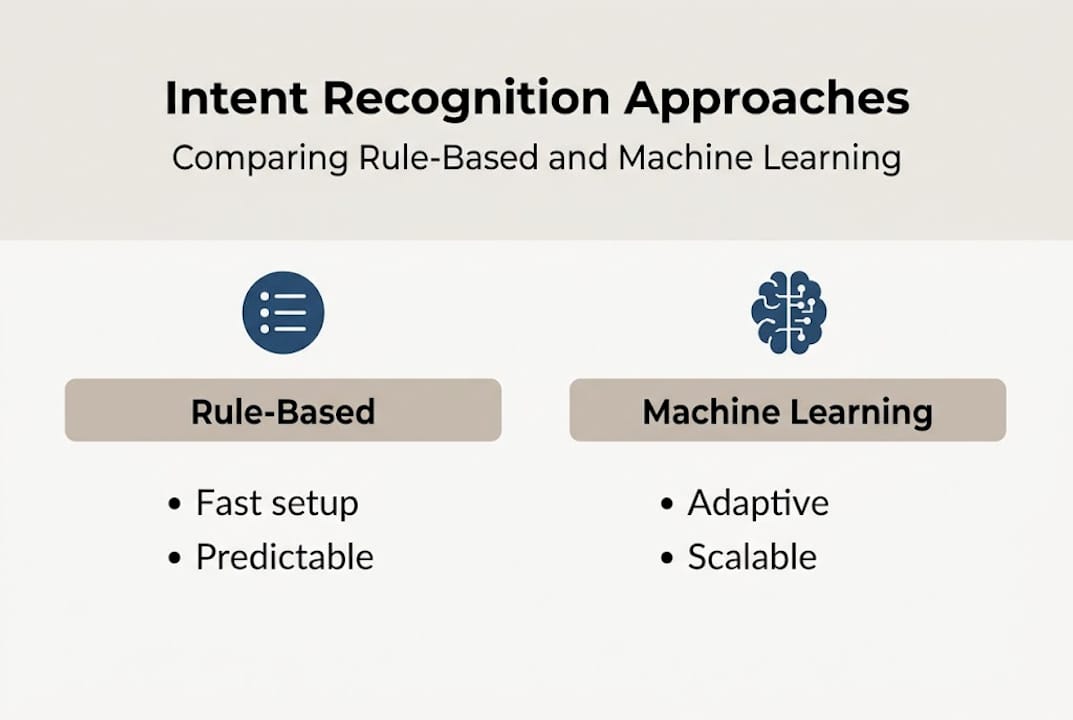
Rule-based systems use predefined patterns and keyword lists. They are easy to set up and highly predictable, making them useful for tightly scoped tasks. The problem is that real customers rarely stay within the script. A single unexpected phrase can break the entire flow.
Machine learning approaches train on historical interaction data to recognize intent patterns. They adapt over time, which is a significant advantage for growing businesses. However, they require substantial labeled datasets to perform well, which can be a barrier for smaller operations.

Deep learning models, particularly those using large language models, excel at understanding context across longer conversations. The AWS Lex platform and similar enterprise tools lean on these hybrid architectures to handle the complexity of real business interactions.
Choosing the right approach depends on several factors relevant to your specific situation:
- Company size: Smaller teams benefit from rule-based or pre-trained ML systems that require less ongoing maintenance.
- Data availability: Deep learning demands large, high-quality datasets. Without them, simpler ML models often outperform.
- Interaction complexity: If customers regularly ask multi-part questions or switch topics mid-conversation, deep learning or multimodal approaches are worth the investment.
For businesses exploring AI-powered support, starting with a hybrid model that combines rule-based reliability with ML adaptability often delivers the fastest path to measurable results.
Edge cases and challenges in real business settings
Deploying intent recognition in a controlled demo environment and deploying it in a live business operation are two very different experiences. Real customers are unpredictable. They use slang, make typos, ask compound questions, and sometimes say things that fall completely outside any trained intent category.
Typical challenges businesses encounter include ambiguous requests where the same phrase could mean multiple things, domain-specific jargon that general models have never encountered, multi-intent utterances where a single message contains two or more distinct goals, and noisy inputs from voice recognition errors. Cultural differences in phrasing add another layer of complexity for businesses operating across regions.
Simple intent models assume users communicate in clean, single-purpose sentences. They do not. When a model encounters an ambiguous or overlapping intent, it either guesses wrong or fails silently, and neither outcome builds customer trust.
Practical solutions that reduce failure rates in production include:
- Setting confidence thresholds so low-scoring predictions trigger clarification questions rather than wrong actions
- Designing fallback intents that gracefully handle out-of-scope queries without frustrating users
- Retraining models specifically on edge cases collected from real interaction logs
- Applying hierarchical classification, where broad intents are identified first before narrowing to specific sub-intents
For businesses building adaptive AI for SMB automation, these failure modes are not hypothetical. They appear within the first weeks of deployment and require systematic processes to address.
The agentic AI limitations literature confirms that even sophisticated systems struggle with edge cases when domain-specific context is absent from training data.
Pro Tip: Build a dedicated edge case library from day one. Capture every interaction where your intent model fails or requests clarification, and use that data to retrain quarterly. Businesses that treat edge cases as ongoing training opportunities consistently outperform those that treat deployment as a one-time event.
A fresh perspective: Why most businesses get intent recognition wrong
The most common mistake we see is businesses selecting a general-purpose AI solution and expecting it to understand the specific language of their industry without customization. General LLMs achieve only 82.7% accuracy versus domain-specific models in enterprise settings, which means roughly one in five customer interactions is misclassified before any edge cases are even considered.
The appeal of plug-and-play solutions is understandable. They promise speed and simplicity. But intent recognition is not a generic problem. A healthcare provider’s patients phrase requests differently than an e-commerce customer or a financial services client. The vocabulary, the stakes, and the acceptable failure rates are all different.
Businesses that succeed with intent recognition invest in three areas that generic tools ignore: domain-specific training data, cultural and linguistic context for their actual customer base, and continuous retraining cycles tied to real interaction outcomes. For leaders serious about business growth with AI automation, the path forward is customization, not convenience.
How SimplyAI can help your business leverage intent recognition
Intent recognition AI, when implemented correctly, transforms how businesses communicate with customers and how efficiently operations run. It reduces manual workload, accelerates response times, and creates interactions that feel genuinely intelligent rather than scripted.
At SimplyAI, we design and implement tailored AI solutions that go beyond generic chatbot deployments. Our AI automation services are built around your specific industry context, customer language, and operational goals. We also develop custom AI agents that handle complex, multi-intent interactions with the kind of accuracy that generic platforms simply cannot match. If you are ready to move from AI experimentation to measurable business results, we are the team to make that happen.
Frequently asked questions
How is intent recognition AI different from regular chatbots?
Intent recognition AI classifies the goal behind user input using advanced models, enabling smarter and more contextual responses, while regular chatbots typically follow rigid, scripted answer trees that break when users deviate from expected phrasing.
What industries benefit most from intent recognition AI?
Retail, customer service, healthcare, and financial services gain the most, because these sectors involve frequent, complex customer interactions where intent classification boosts operational efficiency and reduces the cost of manual handling.
What is the main challenge when implementing intent recognition AI?
Handling ambiguous inputs and edge cases is the primary hurdle. Ambiguous or overlapping intents present significant deployment challenges that require confidence thresholds, fallback flows, and ongoing retraining to manage effectively.
Can intent recognition AI handle multiple languages or accents?
Yes. Multimodal and deep learning approaches are specifically designed to support robustness across language variations, regional dialects, and accents, making them well-suited for businesses operating in multilingual or international markets.
Recommended
- Blockchain for Enterprise: Building Trust Through Transparency — SimplyAI
- Why Every Company Needs a Centralized AI Intelligence Layer — SimplyAI
- Building an AI-First Organization: A Strategic Roadmap — SimplyAI
- The Rise of Digital Workers: AI Agents in the Modern Workplace — SimplyAI
- AI agents in customer support: what works in 2026 | SuperSocial Blog