AI adoption among SMEs surged from 10% in 2018 to 45% in 2025, yet many small and medium business owners still believe artificial intelligence is reserved for tech giants with massive budgets. That misconception costs you competitive advantage every day. AI is not just accessible for SMBs in 2026, it is transforming how you operate, serve customers, and compete in your market. This guide walks you through understanding AI’s real impact on digital transformation, the challenges you will face, the technologies driving change, and practical steps to implement AI strategically for measurable results.
Table of Contents
- Understanding AI’s Impact On Digital Transformation For SMBs
- Challenges SMBs Face Adopting AI In Digital Transformation
- Key AI Technologies Driving SMB Digital Transformation
- Maximizing AI Benefits With Strategic Implementation
- Explore SimplyAI Solutions For Your SMB
- Frequently Asked Questions About AI In Digital Transformation
Key takeaways
| Point | Details |
|---|---|
| AI boosts efficiency and experience | Artificial intelligence personalizes customer service and improves operational efficiency by up to 33% for small businesses. |
| Common adoption barriers exist | SMBs face talent shortages, legacy system integration issues, and data quality challenges when implementing AI solutions. |
| Strategic implementation matters | Aligning AI with workflows and data readiness determines success, not just purchasing technology. |
| Long-term competitive advantage | Strategic AI adoption drives market share growth, innovation capacity, and sustained competitive positioning over time. |
Understanding AI’s impact on digital transformation for SMBs
Artificial intelligence fundamentally changes how small and medium businesses compete by improving customer experience through personalized services and automated interactions. When you implement AI thoughtfully, customer satisfaction increases by up to 25% because your business responds faster, anticipates needs better, and delivers consistent service across every touchpoint. That translates directly to higher retention rates and more referrals without expanding your team.
The operational side delivers equally impressive gains. AI adoption leads to measurable cost savings and efficiency improvements reaching 33% for SMEs that integrate solutions properly. Your team spends less time on repetitive tasks like data entry, invoice processing, or appointment scheduling. AI handles those workflows automatically, freeing your people to focus on strategy, relationship building, and creative problem solving that actually grows your business.
Consider how AI automations transform daily operations across different functions:
- Customer service chatbots resolve common inquiries 24/7 without human intervention
- Inventory management systems predict demand patterns and optimize stock levels automatically
- Marketing automation personalizes email campaigns based on customer behavior and preferences
- Financial forecasting tools analyze historical data to project cash flow and identify cost reduction opportunities
Successful AI implementation requires more than purchasing software. You must align AI solutions with your existing business workflows and ensure your data is organized, accessible, and accurate. A practical AI usage guide helps you map where AI creates the most value in your specific operations. Start by identifying repetitive tasks that consume significant time, then evaluate which AI tools address those pain points most effectively.
Pro Tip: Begin your AI journey by automating one high-volume, low-complexity process like appointment scheduling or customer inquiry routing. Measure the time savings and accuracy improvements over 30 days to build internal confidence before expanding to more complex workflows.
The businesses winning with AI in 2026 share a common approach. They treat AI as a strategic capability, not a magic solution. They invest time understanding their data quality, train teams on new tools, and continuously optimize AI performance based on real results. That discipline separates companies that achieve 33% efficiency gains from those that waste money on underutilized technology.
Challenges SMBs face adopting AI in digital transformation
Your biggest obstacle implementing AI is not the technology itself but the talent gaps and legacy systems standing in your way. Finding employees who understand both AI capabilities and your business needs remains difficult for most SMBs. You cannot simply hire a data scientist and expect transformation. You need people who can translate business problems into AI solutions, then integrate those solutions into existing workflows without disrupting operations.
Legacy systems create expensive integration nightmares. Your current software probably was not designed to work with AI tools. Connecting modern AI platforms to older databases, CRM systems, or accounting software requires custom development work that quickly exceeds initial budgets. Many SMBs discover their existing infrastructure cannot support AI without significant upgrades, turning a promising efficiency project into a costly technology overhaul.
Data quality issues kill AI projects faster than any other factor. Poor data readiness with inconsistent and unstructured data limits what AI can accomplish because algorithms need clean, organized information to generate useful insights. If your customer records contain duplicates, your inventory data lacks consistency, or your financial information sits scattered across multiple systems, AI will amplify those problems rather than solve them.
Common data and integration barriers include:
- Inconsistent data formats across different departments and systems
- Missing or incomplete records that reduce AI accuracy and reliability
- Siloed information that prevents comprehensive analysis and automation
- Inadequate data governance policies that create security and compliance risks
Without a clear strategy, AI becomes an expensive experiment that delivers disappointing results. You must define specific business outcomes before selecting AI tools. Chasing trendy technology without connecting it to revenue growth, cost reduction, or customer satisfaction improvements wastes resources and damages team confidence in digital transformation initiatives.
“AI implementation fails when businesses focus on technology first instead of solving real problems with clean data and integrated workflows.”
The AI skills gap extends beyond technical knowledge. Your team needs training on how AI changes their daily work, what tasks to delegate to machines, and how to interpret AI-generated insights. Resistance to change multiplies when employees fear job loss or feel overwhelmed by new tools. Successful SMBs invest in education and change management alongside technology purchases.
Navigating these challenges requires honest assessment of your current capabilities. Use an AI integration guide to evaluate data readiness, identify skill gaps, and plan system upgrades before committing to specific AI solutions. That preparation work determines whether your AI investment delivers the promised efficiency gains or becomes another underutilized software subscription.
Key AI technologies driving SMB digital transformation
Machine learning enables systems to improve performance automatically by analyzing patterns in your business data. Instead of programming every rule manually, ML algorithms learn from historical information to make predictions about customer behavior, inventory needs, or maintenance requirements. For SMBs, this means recommendation engines that suggest products customers actually want, fraud detection that catches suspicious transactions, and predictive maintenance that prevents equipment failures before they disrupt operations.
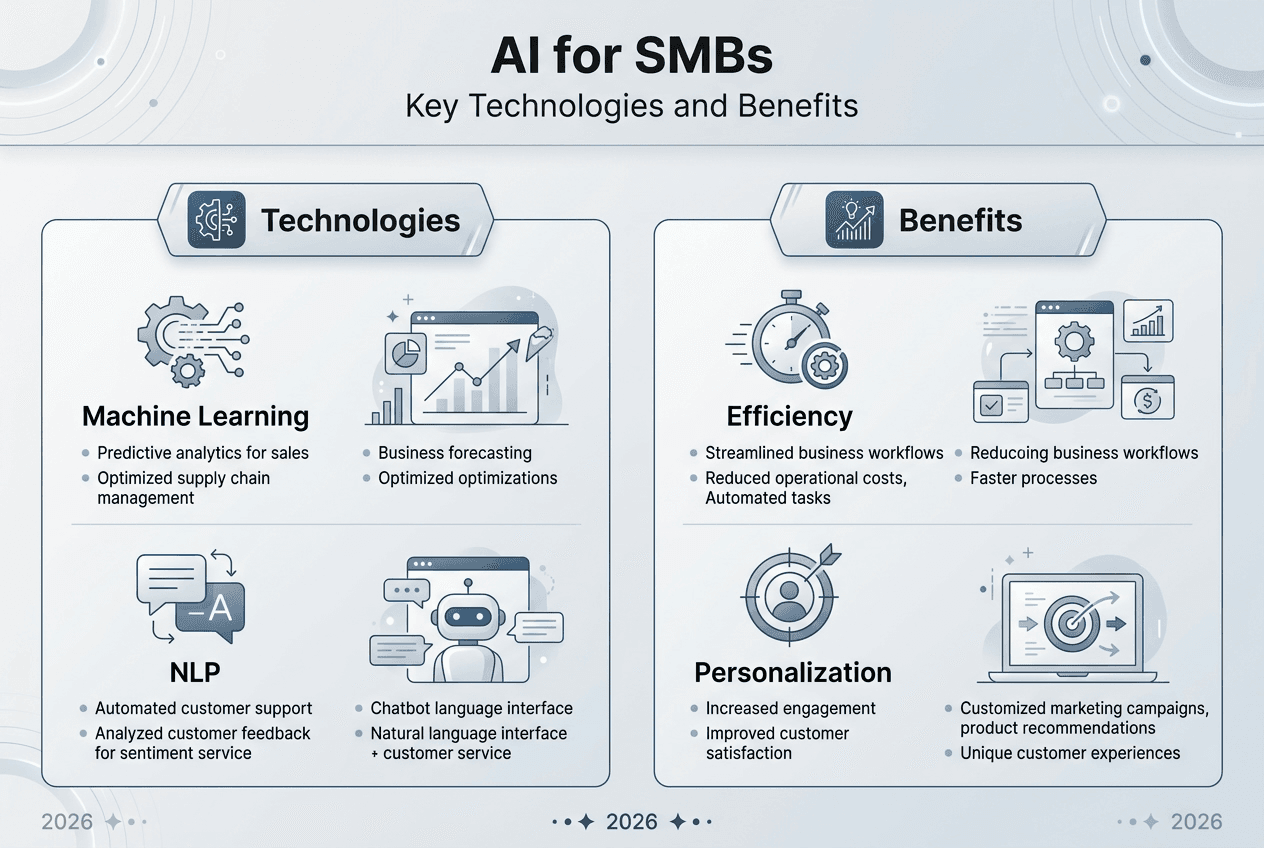
Natural language processing allows computers to understand and generate human language. NLP powers the chatbots handling customer inquiries on your website, the voice assistants scheduling appointments, and the sentiment analysis tools monitoring social media mentions. When customers ask questions in their own words, NLP interprets intent and provides relevant answers without requiring exact keyword matches. This technology makes automation feel more human and accessible.
Generative AI creates new content based on patterns learned from existing examples. In 2026, SMBs use generative AI to draft marketing emails, design product images, write code snippets, and generate report summaries. These technologies enhance efficiency and decision-making by handling creative tasks that previously required human expertise. The key is using generative AI as a starting point that your team refines, not as a replacement for strategic thinking.
SMBs leverage AI across multiple sectors with applications tailored to industry-specific needs. Manufacturing companies use AI for quality control and supply chain optimization. Healthcare providers implement AI for appointment scheduling and patient triage. Financial services firms deploy AI for risk assessment and fraud prevention. Retailers apply AI to personalize shopping experiences and optimize pricing strategies. The technology adapts to your sector’s unique requirements.
Selecting the right AI technologies for your business follows a systematic approach:
- Identify your most time-consuming or error-prone processes that impact customer satisfaction or profitability
- Research which AI technologies specifically address those operational challenges with proven results
- Evaluate vendors based on integration capabilities with your existing systems and support quality
- Start with a pilot project that tests AI effectiveness on a limited scale before full deployment
- Measure results against specific metrics like time savings, error reduction, or revenue increase
- Expand successful pilots gradually while continuously optimizing performance based on real data
Comparing AI technologies helps you match solutions to business needs:
| Technology | Primary Function | Business Impact | Best Use Cases |
|---|---|---|---|
| Machine Learning | Pattern recognition and prediction | Improves forecasting accuracy and automates decisions | Demand planning, customer segmentation, fraud detection |
| Natural Language Processing | Language understanding and generation | Enhances customer communication and reduces support costs | Chatbots, sentiment analysis, document processing |
| Generative AI | Content creation and synthesis | Accelerates content production and reduces creative costs | Marketing copy, product descriptions, report summaries |
| Computer Vision | Image and video analysis | Automates visual inspection and quality control | Product defect detection, security monitoring, inventory counting |
Pro Tip: Choose AI technologies that integrate with your current software ecosystem rather than requiring complete system replacement. Cloud-based AI services with API connections typically offer faster implementation and lower upfront costs than custom-built solutions.
Explore SimplyAI solutions designed specifically for SMB needs, including pre-built integrations with popular business software and industry-specific templates that reduce implementation time. The right technology partner provides not just software but guidance on applying AI effectively within your unique business context.
Maximizing AI benefits with strategic implementation
Assessing data readiness before implementing AI prevents costly failures and ensures your investment delivers promised results. Start by auditing your current data sources to identify gaps, inconsistencies, and quality issues that would undermine AI accuracy. Clean your data systematically by removing duplicates, standardizing formats, and filling critical missing information. Establish data governance policies that maintain quality over time through regular validation and clear ownership responsibilities.
Streamlining workflows alongside AI implementation multiplies efficiency gains. Map your current processes to identify bottlenecks where AI can have the greatest impact. Redesign workflows to take full advantage of AI capabilities rather than simply automating existing inefficient processes. Train your team on new procedures that combine human judgment with AI insights, creating hybrid workflows that leverage the strengths of both.
Comparing implementation approaches helps you choose the right path:
| Approach | Advantages | Disadvantages | Best For |
|---|---|---|---|
| DIY Implementation | Lower initial costs, complete control, faster decisions | Requires internal expertise, longer learning curve, limited support | Tech-savvy teams with clear AI use cases |
| Managed Services | Expert guidance, faster deployment, ongoing optimization | Higher costs, less control, potential vendor dependence | Businesses lacking AI expertise or resources |
AI delivers results only when aligned with correct data, integrated workflows, and continuous optimization. Set specific performance metrics before deployment, then monitor those metrics weekly to catch issues early. Common metrics include accuracy rates for predictions, time savings on automated tasks, error reduction percentages, and customer satisfaction scores for AI-powered interactions.
Continuous improvement practices separate successful AI implementations from disappointing ones:
- Review AI performance dashboards weekly to identify declining accuracy or unexpected patterns
- Collect user feedback systematically to understand where AI helps or frustrates your team and customers
- Retrain models quarterly with fresh data to maintain relevance as business conditions change
- Invest in ongoing skill development so your team grows more capable of leveraging AI effectively
Pro Tip: Create a dedicated AI optimization role or assign ownership to someone who monitors performance, coordinates improvements, and champions AI adoption across your organization. Without clear ownership, AI initiatives lose momentum after initial deployment.
Strategic AI adoption drives market share and innovation by building competitive advantages that compound over time. Focus on long-term capability building rather than chasing short-term efficiency wins. The businesses that dominate their markets in 2026 treat AI as a core competency, not a side project. They systematically expand AI applications across operations, develop internal expertise, and continuously refine their approach based on measured results.
Building an AI-first organization requires cultural change alongside technical implementation. Encourage experimentation by celebrating learning from failed pilots, not just successful deployments. Share AI success stories internally to build momentum and overcome resistance. Connect AI initiatives directly to strategic business goals so everyone understands how automation and intelligence support growth, not just cost cutting.
Explore SimplyAI solutions for your SMB
Transforming your business with AI does not require a massive technology team or enterprise budget. SimplyAI specializes in helping small and medium businesses implement practical AI automations and intelligent agents that deliver measurable efficiency gains and enhanced customer experiences. We understand the unique challenges SMBs face because we focus exclusively on making AI accessible and effective for companies at your scale.
Our AI automations services streamline repetitive workflows across marketing, operations, and customer service, freeing your team to focus on strategic work that drives growth. We design AI agents that handle customer inquiries, qualify leads, and support decision-making with intelligent recommendations tailored to your business context. Every solution integrates with your existing systems and aligns with your specific operational needs.
Visit SimplyAI to explore how practical AI implementation can accelerate your digital transformation journey with solutions designed for real business results, not just impressive technology demos.
Frequently asked questions about AI in digital transformation
What are the first steps for SMBs adopting AI?
Start by identifying high-volume, repetitive tasks that consume significant time and cause frequent errors. Audit your data quality to ensure AI will have clean information to work with. Select one specific process to automate as a pilot project, measure results carefully, then expand based on proven success.
How to overcome data challenges when starting AI?
Clean your existing data systematically by removing duplicates, standardizing formats, and filling critical gaps before implementing AI solutions. Establish data governance policies that assign clear ownership and maintain quality standards. Start with AI applications that tolerate imperfect data while you improve information quality over time.
Which AI technologies are best suited for small businesses?
Natural language processing for customer service chatbots, machine learning for sales forecasting and customer segmentation, and generative AI for marketing content creation deliver strong ROI for most SMBs. Choose technologies that integrate easily with your current software and address your most pressing operational challenges.
How can AI improve customer experience effectively?
AI personalizes interactions by analyzing customer history and preferences to deliver relevant recommendations and responses. Chatbots provide instant support 24/7 for common questions, while predictive analytics help you anticipate customer needs before they ask. The key is using AI to enhance human service, not replace personal relationships entirely.
What common mistakes should SMBs avoid with AI?
Avoid purchasing AI tools without defining specific business outcomes you want to achieve. Do not neglect data quality or underestimate integration complexity with legacy systems. Resist the temptation to automate everything at once instead of starting small and expanding based on results. Never implement AI without training your team on how to work effectively with new tools. Learn more about AI automation for entrepreneurs to avoid these pitfalls.
Recommended
- How AI Automation Is Reshaping Enterprise Operations in 2026 — SimplyAI
- Blog — SimplyAI
- Blockchain for Enterprise: Building Trust Through Transparency — SimplyAI
- The Rise of Digital Workers: AI Agents in the Modern Workplace — SimplyAI
- Árajánlat készítés - AI tanácsadás és bevezetés egy kézben.
- AI Implementation - Virality Creative