
Small and medium-sized businesses face mounting pressure to do more with less. AI promises to automate workflows, optimize customer experiences, and unlock measurable growth, but choosing the right strategies can feel overwhelming. With countless tools and conflicting advice, SMB owners need a clear framework to evaluate which AI solutions deliver real impact. This guide provides practical criteria to assess AI-powered business strategies, explores proven automation and customer experience options, and addresses common risks to help you make confident decisions that drive efficiency and revenue.
Table of Contents
- Key takeaways
- How to evaluate AI-powered business strategies for small and medium businesses
- Top AI-powered strategies to automate workflows and reduce manual tasks
- Enhancing customer experience with AI-powered tools
- Common pitfalls and risk management in AI adoption for SMBs
- Explore SimplyAI’s solutions to empower your business with AI
- Frequently asked questions
Key Takeaways
| Point | Details |
|---|---|
| Time savings | Identify your most time consuming tasks and map workflows to reveal automation opportunities. |
| Pilot approach | Pilot one process at a time to reduce risk and scale after proof. |
| Data integration | Choose AI tools that integrate with existing data sources and systems to prevent silos. |
| Vendor evaluation | Evaluate vendors on workflow fit, scalability, and ongoing support to avoid missteps. |
How to evaluate AI-powered business strategies for small and medium businesses
Selecting AI solutions that align with your operations requires a structured approach. Start by identifying your most time-consuming manual tasks, whether invoice processing, customer inquiries, or inventory tracking. These pain points reveal where automation delivers immediate value.
Map existing workflows to pinpoint automation opportunities. Document each step, from trigger to completion, noting where human intervention slows progress. This mapping exercise uncovers bottlenecks and highlights processes ripe for AI enhancement. Set clear triggers and expected outcomes for AI implementations to measure success objectively.
Pilot AI solutions with a small scope before scaling. Testing one process reduces risk and builds organizational confidence. For example, automate appointment scheduling for a single department before rolling out company-wide. AI automation methodology for SMBs emphasizes identifying painful tasks, mapping workflows, defining triggers and outcomes, piloting one process, scaling after proof, integrating data sources, and training staff with 25% of project budget.
Integrate AI tools with your existing data sources for efficiency. Disconnected systems create information silos and duplicate work. Choose platforms that connect seamlessly with your CRM, accounting software, and communication channels. Allocate sufficient budget for staff training and change management. Without proper education, even the best AI tools fail to deliver results.
Pro Tip: Document current process completion times and error rates before implementing AI. These baseline metrics prove ROI and justify future investments.
Evaluate vendors on three dimensions: workflow fit, scalability, and support quality. Does the tool address your specific pain point? Can it grow with your business? Will the vendor provide ongoing assistance? Answering these questions prevents costly missteps. For deeper insights on building effective AI systems, explore our AI automation guide for SMBs.
Top AI-powered strategies to automate workflows and reduce manual tasks
Robotic process automation (RPA) transforms repetitive administrative tasks. RPA bots handle data entry, report generation, and email responses with zero errors. Unlike human workers, these digital assistants operate 24/7 without breaks or vacation time.
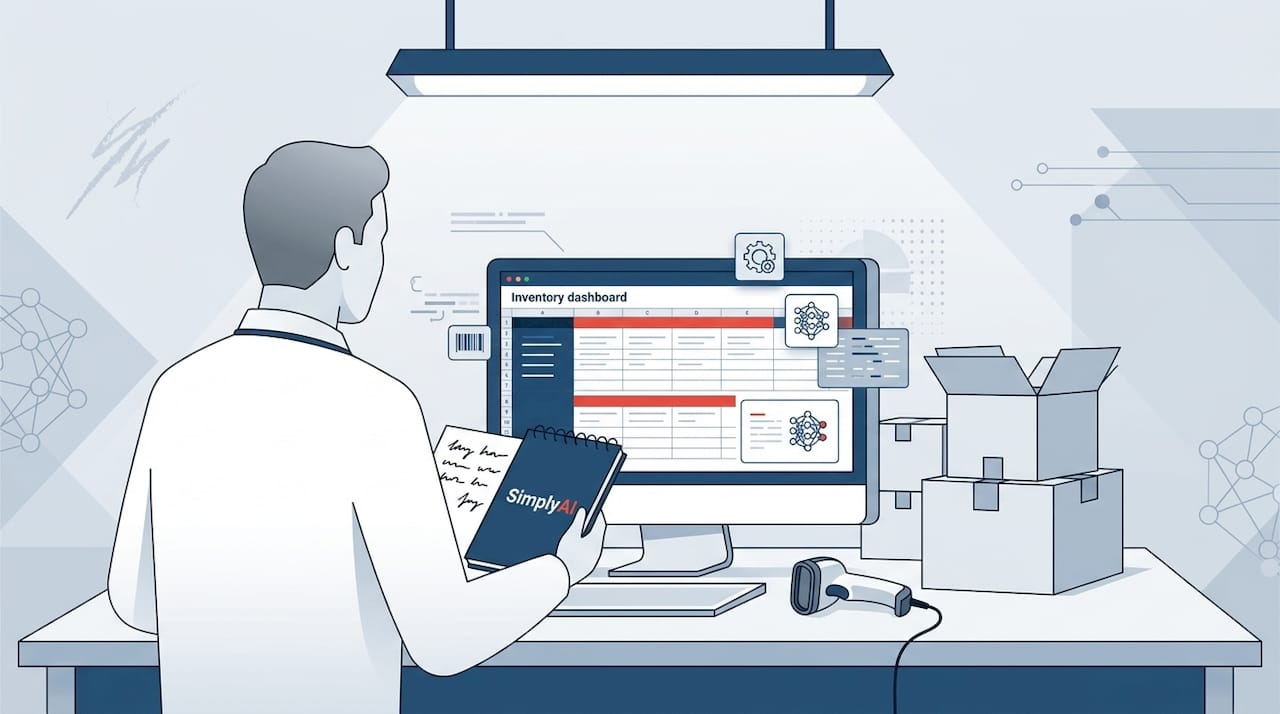
AI-powered scheduling and inventory management tools eliminate coordination headaches. Smart scheduling systems analyze availability, preferences, and workload to optimize appointments automatically. Inventory platforms predict demand patterns, trigger reorders, and prevent stockouts without manual intervention. Small businesses using AI automation save 20-22 hours weekly, reduce operational costs by 35-45%, and achieve ROI of 300-500%.
Intelligent document processing reduces manual data entry errors. AI extracts information from invoices, receipts, and contracts with 99% accuracy. This technology converts unstructured documents into structured data your systems can process immediately.
Implementing these strategies follows a clear path:
- Prioritize tasks by time consumption and error frequency
- Choose vendors with proven SMB track records and integration capabilities
- Set KPIs like hours saved, cost reduction, and accuracy improvement
- Monitor progress weekly during the first month, then monthly
- Adjust workflows based on performance data and staff feedback
Benefits extend beyond time savings. Lower costs improve profit margins. Improved operational accuracy enhances customer satisfaction. Staff freed from tedious work focus on relationship building and strategic initiatives.
Pro Tip: Start with one high-volume, low-complexity process. Success here builds momentum for tackling more challenging automations.
Common automation candidates include:
- Invoice processing and accounts payable workflows
- Customer onboarding and document collection
- Appointment reminders and follow-up communications
- Inventory tracking and reorder management
- Report generation and data compilation
Discover how SimplyAI implements these solutions through our AI automation services, designed specifically for small and medium-sized businesses seeking measurable efficiency gains.
Enhancing customer experience with AI-powered tools
Deploy AI chatbots for 24/7 customer support to increase first-contact resolution rates. Modern chatbots understand context, handle complex queries, and escalate to humans only when necessary. AI chatbots and virtual agents provide 24/7 support with over 70% first-contact resolution, use data analysis for personalization, and meet the 95% of consumers who expect explained AI decisions.
These tools transform customer interactions from reactive to proactive. Chatbots anticipate needs based on browsing behavior, purchase history, and previous inquiries. This anticipation creates seamless experiences that build loyalty.
Use AI analytics to deliver tailored product recommendations and personalized marketing. Recommendation engines analyze thousands of data points to suggest products customers actually want. Personalized email campaigns achieve open rates 2-3 times higher than generic blasts.
Implement explainable AI practices to build consumer trust and transparency. When AI makes decisions affecting customers, explain the reasoning in plain language. Transparency about data usage and algorithmic logic addresses privacy concerns and strengthens relationships.
“Customers don’t fear AI. They fear being misunderstood by systems that make opaque decisions without human oversight.”
Benefits include improved customer satisfaction scores, higher loyalty and repeat purchase rates, and increased revenue per customer. AI-powered customer experience tools pay for themselves through reduced support costs and increased lifetime value.
Key implementation considerations:
- Train chatbots on your actual customer conversations for authentic responses
- Test recommendation algorithms with diverse customer segments before launch
- Provide easy escalation paths to human agents for complex issues
- Monitor sentiment analysis to catch dissatisfaction early
For comprehensive guidance on implementing these tools effectively, review our AI-powered customer support guide with real-world SMB examples and best practices.
Common pitfalls and risk management in AI adoption for SMBs
SMB AI failures stem from disconnected systems, unclear accountability, regulatory gaps, and AI hallucinations in edge cases. Hidden risks of AI automation include disconnected systems, no ownership or escalation paths, compliance gaps, and hallucinations requiring human-in-loop oversight and clear boundaries.
Disconnected systems create data silos that undermine AI effectiveness. When your chatbot can’t access inventory data, it provides inaccurate information. When your scheduling tool doesn’t sync with your CRM, double bookings occur. Integration failures waste money and frustrate customers.
Lack of clear accountability dooms AI projects. Assign specific owners for each AI implementation. Define escalation paths for when systems fail or produce unexpected results. Without ownership, problems languish unresolved.
Regulatory gaps expose businesses to legal risk. AI systems must comply with data protection laws, accessibility requirements, and industry-specific regulations. Ignoring compliance creates liability that far exceeds implementation costs.
AI hallucinations occur when systems generate plausible but incorrect information. In edge cases outside training data, AI confidently provides wrong answers. Human-in-the-loop approaches mitigate this risk by keeping humans involved in critical decisions.
| Risk Management Approach | Strengths | Weaknesses | Best For |
|---|---|---|---|
| Continuous monitoring | Catches issues quickly, adapts to changes | Requires ongoing resources | High-volume customer interactions |
| Rigid controls | Prevents unauthorized actions, ensures compliance | Limits AI flexibility and learning | Regulated industries, financial processes |
| Hybrid models | Balances safety and innovation, scales efficiently | More complex to implement | Most SMB scenarios |
Implement these safeguards:
- Require human review for high-stakes decisions like credit approvals or medical advice
- Set confidence thresholds that trigger human escalation
- Conduct regular audits of AI outputs for accuracy and bias
- Maintain detailed logs for compliance and troubleshooting
Importance of compliance and clear ownership cannot be overstated. Document who approves AI decisions, who monitors performance, and who handles failures. This clarity prevents finger-pointing and ensures rapid response to issues.
Learn how to navigate these challenges through our guide on adaptive AI risks and solutions, featuring frameworks for sustainable AI adoption.
Explore SimplyAI’s solutions to empower your business with AI
Ready to transform your operations with proven AI strategies? SimplyAI offers tailored AI automation to streamline workflows and reduce manual tasks that drain your team’s time. Our solutions address the specific challenges SMBs face, from invoice processing to customer support.
Our AI automation services eliminate repetitive work so your staff focuses on growth activities. We design systems that integrate seamlessly with your existing tools, ensuring data flows smoothly across platforms.
Our AI agent solutions provide intelligent customer interaction capabilities that work around the clock. These agents handle inquiries, qualify leads, and escalate complex issues to your team with full context.
Through our AI corporate education programs, your team masters AI adoption and best practices. We build confidence and skills so your organization maximizes AI impact. Partnering with SimplyAI ensures expert guidance for measurable SMB growth, from strategy through implementation and beyond.
Frequently asked questions
What tasks are best suited for AI automation in SMBs?
Repetitive, data-intensive, and rule-based tasks such as invoice processing, scheduling, and customer inquiries are ideal for AI automation. AI excels at freeing staff from manual workloads to focus on strategic activities like relationship building and business development.
How can SMBs avoid common AI implementation failures?
Ensure integrated systems, clear ownership, compliance adherence, and include human review to prevent risks like hallucinations and disconnections. Pilot projects with close monitoring improve success rates by identifying issues before full-scale deployment.
What benefits can SMBs expect from AI-powered customer experience tools?
Faster response times, 24/7 support, personalized interactions, and improved customer satisfaction drive retention and growth. AI chatbots can achieve over 70% first-contact resolution, reducing support costs while improving service quality.
How should SMBs train their staff for AI adoption?
Invest about 25% of AI project budget in training to build confidence and skills across your organization. Ongoing education ensures smooth integration and maximizes AI impact by helping staff understand how to work effectively alongside automated systems.
Recommended
- Blog — SimplyAI
- Blockchain for Enterprise: Building Trust Through Transparency — SimplyAI
- Building an AI-First Organization: A Strategic Roadmap — SimplyAI
- The Rise of Digital Workers: AI Agents in the Modern Workplace — SimplyAI
- AI Adoption for SMBs: Boosting Efficiency and Growth - BizDev Strategy