
For years, AI personalization was the exclusive domain of Amazon, Netflix, and Google. Those companies had the data science teams, the infrastructure, and the budgets to make it work. That era is over. Hyper-personalization is now accessible to SMBs, and the businesses moving fastest are not the biggest ones. They are the most adaptive ones. This article covers what AI personalization actually is, which technologies power it, the real benefits and risks, and how you can start implementing it without a massive budget or a team of engineers.
Table of Contents
- What is AI personalization and why it matters
- How AI personalization works: Key technologies and methods
- Top benefits for SMBs: Real-world results
- Risks, ethics, and the ‘creepy factor’: Guardrails for personalization
- How to get started with AI personalization in your business
- Supercharge your business with SimplyAI’s personalization tools
- Frequently asked questions
Key Takeaways
| Point | Details |
|---|---|
| Definition of AI personalization | AI personalization uses data and automation to create tailored experiences for each customer. |
| Key technologies | Machine learning and real-time automation make AI personalization possible for SMBs. |
| Business benefits | Adopting AI personalization boosts customer satisfaction, engagement, and revenue. |
| Risks and ethics | Safe, ethical use of AI personalization requires clear guardrails and customer transparency. |
| Getting started | SMBs can start small by focusing on one channel and building data-driven practices. |
What is AI personalization and why it matters
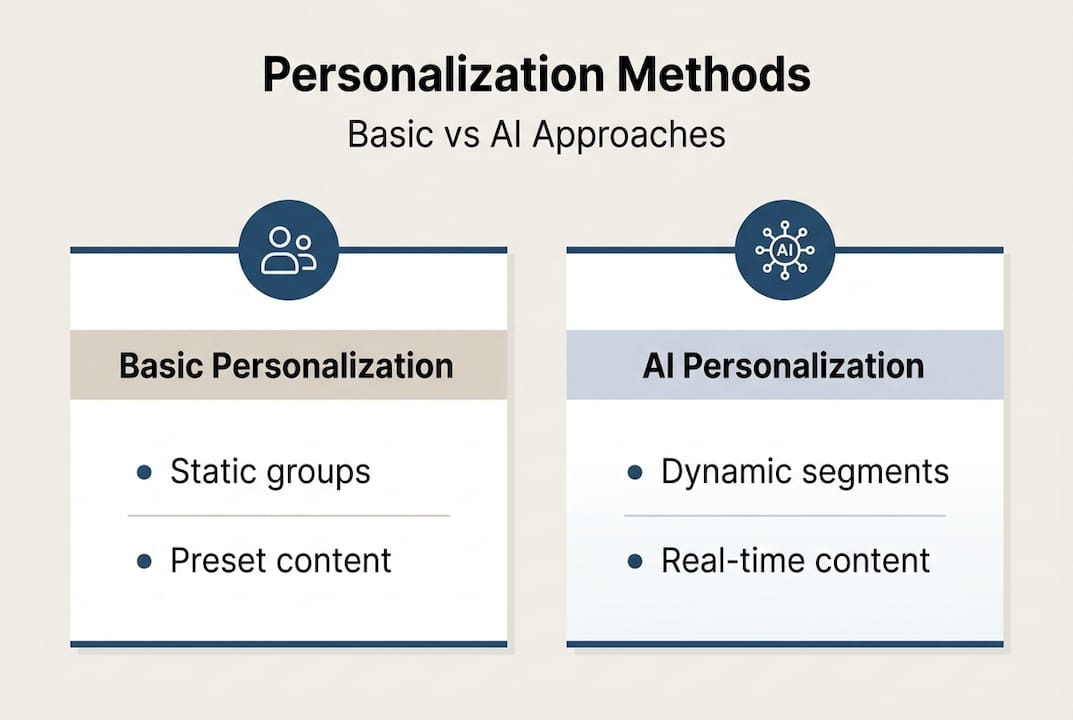
AI personalization is not just showing someone their first name in an email subject line. It is a fundamentally different approach to customer experience. AI personalization tailors content, recommendations, and actions dynamically for each user based on live data and behavioral patterns, adjusting in real time as that person interacts with your business. Traditional personalization uses static rules: if a customer bought product A, show them product B. AI personalization learns continuously, updating its model of each customer with every new interaction.
Why does this matter for SMBs specifically? Because the competitive landscape has shifted. Large brands have been using these tools for years, conditioning customers to expect relevant, timely, and contextual experiences. When your business delivers generic messaging, customers notice. They move on.
The business case is clear. Businesses using AI-driven business strategies for personalization can lift revenue by up to 15%, according to industry research. That is not a marginal gain. For a business generating $500,000 annually, that is $75,000 in additional revenue from smarter communication alone.
Two myths deserve direct rebuttal. First, the idea that AI personalization is too complex for smaller teams. Modern platforms abstract away the technical complexity, letting you configure rules and goals without writing a single line of code. Second, the cost myth. Cloud-based tools have made sophisticated personalization engines available at price points that fit SMB budgets, often starting at less than the cost of a part-time employee.
| Capability | Basic personalization | AI personalization |
|---|---|---|
| Segmentation | Static groups | Dynamic, real-time |
| Data used | Historical only | Live behavioral data |
| Adaptation | Manual updates | Continuous learning |
| Scale | Limited | Scales automatically |
| Accuracy | Rule-based | Pattern-driven |
How AI personalization works: Key technologies and methods
Understanding the mechanics helps you make smarter decisions about tools and implementation. At its core, AI personalization relies on three pillars: data collection, machine learning models, and automated delivery.
Data collection is the foundation. Your system gathers behavioral signals such as pages visited, products viewed, time spent, purchase history, and email engagement. This data is then structured and cleaned, a process known as AI data preprocessing, to remove noise and inconsistencies before it feeds into any model. AI personalization is powered by structured data, machine learning algorithms, and continuous optimization, which means the quality of your inputs directly determines the quality of your outputs.

Machine learning models then identify patterns across thousands of customer interactions. Natural language processing, or NLP, helps the system understand intent from text-based inputs like search queries or support messages. Automated testing, often called A/B or multivariate testing, runs continuously in the background to refine which messages, offers, or product suggestions perform best for which segments.
The practical methods SMBs use most often include dynamic segmentation, real-time content swapping on websites, and product or content recommendation engines. A centralized AI layer can connect these methods across channels so your email, website, and chat all reflect the same understanding of each customer.
Pro Tip: You do not need to build a data warehouse before you start. Most SMBs already have usable data in their email platform and website analytics. Start there, apply basic segmentation, and let the system learn from real interactions before expanding to more complex methods. Reviewing AI personalization best practices can help you avoid common setup mistakes.
Here is a practical sequence for getting the technology working:
- Audit your existing data sources (email lists, website analytics, CRM records).
- Choose one channel to personalize first, such as email or your homepage.
- Select a tool that integrates with your existing stack.
- Define two or three customer segments based on behavior, not just demographics.
- Launch a test campaign and measure engagement against your baseline.
- Use the results to refine your segments and expand to additional channels.
Top benefits for SMBs: Real-world results
The tangible results of AI personalization show up across three areas: customer satisfaction, marketing efficiency, and long-term retention.
On the customer satisfaction side, personalized experiences reduce friction. When a returning customer lands on your website and sees products relevant to their previous purchases, they spend less time searching and more time buying. When your support chatbot recognizes their account history, resolution times drop. These small moments compound into a meaningfully better experience.
Marketing efficiency improves because you stop spending budget on audiences that will not convert. Precision targeting means your ad spend, email sends, and promotional offers reach the people most likely to respond. Personalization leads to higher engagement and revenue in SMBs, and the mechanism is straightforward: relevant messages get opened, clicked, and acted on at higher rates than generic ones.
Retention is where the long-term ROI compounds. Acquiring a new customer costs five to seven times more than retaining an existing one. When your communications feel relevant and timely, customers return more often and spend more per visit. Becoming an AI-first business is not about replacing human relationships. It is about making every automated touchpoint feel as informed and attentive as your best salesperson.
Pro Tip: Start with the channel where you already see the highest engagement. If your email open rates are strong, personalize email first. If your website drives most conversions, focus on dynamic content there. Build momentum with early wins before expanding.
Risks, ethics, and the ‘creepy factor’: Guardrails for personalization
Personalization brings real value, but it also carries real risks. Getting this wrong does not just hurt campaign performance. It damages trust, and trust is far harder to rebuild than it is to lose.
The so-called creepy factor emerges when personalization crosses from helpful to intrusive. Showing a customer a product they browsed yesterday feels useful. Referencing a conversation they had in a physical store, or targeting them based on inferred health or financial data, feels invasive. The line is not always obvious, which is why hyper-personalization risks include echo chambers and privacy concerns that can erode the very trust you are trying to build.
Echo chambers are a subtler risk. When recommendation engines only surface content or products similar to what a customer has already seen, they narrow that person’s exposure to your full catalog. Over time, this can reduce average order value and limit discovery, the opposite of what personalization is supposed to achieve.
Regulations add a compliance dimension. GDPR in Europe and CCPA in California impose strict requirements on how you collect, store, and use personal data. Even if your business operates primarily in the United States, customers in regulated jurisdictions may interact with your website. Ethical guidelines are crucial to prevent negative customer reactions and legal exposure. Reviewing data ethics in AI is a practical starting point for building a compliant framework.
“Transparency is not just a legal requirement. It is a competitive advantage. Customers who understand how their data is used are more likely to share it willingly, giving you better inputs and better results.”
Practical guardrails every SMB should implement include the following:
- Be transparent about data collection in plain language, not legal boilerplate.
- Give customers meaningful control over their preferences and data.
- Practice data minimization: collect only what you actually use.
- Avoid using sensitive inferred data such as health, financial stress, or relationship status.
- Audit your recommendation logic periodically to check for echo chamber effects.
For businesses building more advanced systems, ethical AI agent design should be a design requirement from day one, not an afterthought.
How to get started with AI personalization in your business
The businesses that gain the most from AI personalization are not the ones with the largest budgets. They are the ones that start early and iterate consistently. Brands embracing AI personalization early create durable competitive advantages that are difficult for slower-moving competitors to close.
Here is a practical roadmap for SMBs starting from scratch:
- Pick one channel. Email marketing is the lowest-friction starting point for most SMBs because the data is already structured and the tools are mature.
- Clean your existing data. Remove duplicates, fill in missing fields, and segment your list by at least one behavioral attribute such as purchase frequency or product category interest.
- Choose a tool that fits your stack. Look for platforms that integrate with your existing CRM or email provider and offer pre-built personalization templates.
- Define a measurable goal. Increased open rate, higher click-through rate, or improved conversion rate on a specific product page are all concrete targets.
- Launch, measure, and iterate. Run your first personalized campaign, compare results to your baseline, and adjust your segments or messaging based on what the data shows.
- Expand gradually. Once one channel is performing well, apply the same logic to your website, your chatbot, or your paid advertising.
Pro Tip: Use preset automation templates to accelerate your first deployment. Platforms that offer pre-configured workflows let you see results in days rather than weeks. Exploring AI automation tools and reviewing AI prompt examples can dramatically shorten your learning curve and help your team get comfortable with AI-driven workflows before building more complex systems.
Staff training matters more than most SMB owners expect. The technology is only as effective as the people configuring and interpreting it. Invest time in helping your marketing and customer service teams understand what the system is doing and why, so they can make informed decisions when the data points in unexpected directions.
Supercharge your business with SimplyAI’s personalization tools
If the roadmap above feels like the right direction but the execution feels uncertain, that is exactly where SimplyAI can help. We work with small and medium-sized businesses to design and deploy AI personalization systems that deliver measurable results without requiring an in-house data science team.
Our AI personalization automations cover everything from email segmentation and dynamic content to CRM-connected workflows that adapt to customer behavior in real time. For businesses ready to go further, our AI agents for SMBs can handle personalized customer interactions autonomously across multiple channels. And if you want to accelerate your team’s ability to work with AI, our library of AI prompt templates gives you ready-to-use frameworks built specifically for business applications. The shift toward personalized, AI-driven customer experience is already underway. The question is whether your business leads it or follows.
Frequently asked questions
How is AI personalization different from traditional personalization?
AI personalization adapts recommendations in real time using live behavioral data, while traditional personalization relies on static customer segments that are updated manually and infrequently.
Is AI personalization expensive for small businesses?
SMBs can access personalization tools affordably through cloud-based platforms, many of which offer tiered pricing that scales with your business size and usage volume.
Are there privacy risks with AI-powered personalization?
Yes, and they are manageable. Ethical frameworks and customer transparency help SMBs stay compliant with regulations like GDPR and CCPA while maintaining the customer trust that makes personalization effective in the first place.
What is the first step to start AI personalization in my business?
Starting simple with available data is the recommended approach. Choose one channel such as email marketing, segment your existing list by behavior, and run a single personalized campaign before expanding further.