
TL;DR:
- AI tools can increase task completion but may reduce overall productivity due to verification and overhead.
- Humans excel in tasks requiring empathy, judgment, and creativity, which AI still struggles to replicate.
- A hybrid approach combining rule-based automation, AI, and human effort delivers optimal business results.
When MIT researchers studied AI-assisted developers, they expected to see dramatic productivity gains. Instead, they found something more complicated: while developers completed 26% more tasks using AI tools, verification requirements and implementation overhead actually caused overall productivity to drop by 20% in some environments. That finding should give every business owner pause. AI automation is not a guaranteed shortcut. It is a powerful set of tools that, when applied thoughtfully, can reshape how your business operates and competes in 2026.
Table of Contents
- Understanding AI automation and manual work
- Productivity, accuracy, and cost: What the data shows
- Best-fit use cases: When to automate, when to stay manual
- The hybrid advantage: Combining AI and human strengths
- Our take: What most guides miss about AI vs manual work
- Get started with AI automation for your business
- Frequently asked questions
Key Takeaways
| Point | Details |
|---|---|
| AI boosts task completion | AI automation can help complete more tasks quickly, but actual productivity depends on the implementation. |
| Manual work excels in judgment | Humans outperform machines in empathy and complex decision-making, making manual workflows essential for certain roles. |
| Hybrid strategies win | Combining AI automation with human strengths often delivers the best business results. |
| Careful evaluation needed | Choosing between automation and manual work requires analyzing workflows and matching tools to the task. |
Understanding AI automation and manual work
Before comparing these approaches, it helps to define them clearly. Manual work refers to any task performed by a human using judgment, experience, and contextual awareness. It is flexible by nature and well-suited to situations where the rules are ambiguous or the stakes require genuine empathy.
Rule-based automation, often called traditional automation, operates on a simple principle: if this happens, then do that. Think of automated invoice routing or scheduled email reminders. These systems are fast and consistent, but they break down the moment a situation falls outside their predefined rules. You can explore different automation types to understand where each fits in a modern business stack.
AI automation is a different category entirely. Rather than following fixed logic, AI adapts using pattern recognition and learns from data over time. Large language models, computer vision, and AI agent frameworks allow systems to handle unstructured inputs, like a customer’s typed complaint or a scanned document, and respond in ways that feel contextually intelligent. This adaptability is what makes AI automation genuinely transformative, and also genuinely complex to implement.
Here is a quick comparison of the three approaches:
| Approach | Flexibility | Best for | Key limitation |
|---|---|---|---|
| Manual work | High | Judgment, empathy, creativity | Time-intensive, not scalable |
| Rule-based automation | Low | Repetitive, structured tasks | Breaks on edge cases |
| AI automation | Medium-High | Unstructured, adaptive tasks | Requires data, oversight, setup |
Most successful small and medium-sized businesses (SMBs) do not pick just one of these lanes. They combine all three strategically, reserving human effort for the moments that matter most, applying rule-based systems where consistency is paramount, and deploying AI where adaptability creates genuine leverage. That hybrid approach is where the real opportunity lives.
Productivity, accuracy, and cost: What the data shows
Numbers cut through the noise faster than any opinion. So what does the evidence actually say about performance?
The MIT Copilot research is the most cited data point in this conversation. AI tools helped developers complete more tasks, but the net effect on productivity was uneven. In environments with strong validation workflows, gains were real. In environments where teams had to manually verify AI outputs extensively, productivity dropped. This is not an indictment of AI. It is a warning about implementation quality.

Beyond software development, the picture is more encouraging. In customer support and data processing, AI automation has delivered time savings of 60% to 73% on specific task types. Chatbots that handle routine support queries allow human agents to focus on escalations, complex complaints, and relationship-sensitive conversations. That reallocation of effort often improves both employee satisfaction and customer outcomes. You can find practical automation efficiency tips for common SMB scenarios to understand what realistic gains look like.
Here is a data-driven comparison of key metrics:
| Metric | Manual work | Rule-based automation | AI automation |
|---|---|---|---|
| Productivity uplift | Baseline | 20-40% for structured tasks | 26-73% (task-dependent) |
| Error rate | Variable, human-driven | Low for defined tasks | Low, but requires validation |
| Upfront cost | Low | Medium | Medium to High |
| Hidden costs | Fatigue, turnover | Maintenance, rigidity | Data prep, oversight, retraining |
| Scalability | Low | Medium | High |
One finding that often surprises business owners: manual work consistently outperforms automation in tasks requiring what researchers call EPOCH skills. EPOCH stands for Empathy, Perception, Complex judgment, Original thinking, and Human interaction. These are the capabilities where human workers genuinely excel and where AI systems still struggle to replicate the nuance that customers and partners expect.
“The data does not say AI replaces human work. It says AI changes what human work looks like, and the businesses that understand this distinction will be the ones that grow.”
Best-fit use cases: When to automate, when to stay manual
Knowing the theory is one thing. Applying it to your specific business is another. Here is a structured way to think about where each approach belongs.
First, AI and automation best serve repetitive, high-volume tasks with clear inputs and outputs. Think data entry, invoice processing, appointment scheduling, FAQ responses, and order confirmations. These are areas where speed, consistency, and volume matter more than nuance.
Manual work, on the other hand, should lead wherever empathy and complex judgment are essential: managing a key client relationship, navigating a sensitive complaint, crafting a brand story, or making a hiring decision. These are not tasks where speed is the priority. Getting them right is.
Here is a step-by-step framework for evaluating any task in your business:
- Identify the task type. Is it repetitive and rule-bound, or does it vary significantly based on context?
- Assess volume. High-volume repetitive tasks are prime automation candidates. Low-volume complex tasks rarely justify the setup cost.
- Evaluate error tolerance. If mistakes are costly or visible to customers, plan for human oversight regardless of what you automate.
- Map the decision points. Anywhere a human must exercise judgment is a place to keep humans in the loop, at least initially.
- Pilot before scaling. Test automation on a small slice of work, measure actual outcomes, and expand based on real data rather than projections.
For a deeper operational framework, the SMB automation guide walks through industry-specific scenarios that can save significant planning time.
Pro Tip: Start by automating the most repetitive, lowest-stakes tasks in your workflow before layering in AI for more adaptive scenarios. This builds team confidence, surfaces integration issues early, and delivers quick wins that fund further investment.
The hybrid advantage: Combining AI and human strengths
The most productive organizations in 2026 are not choosing between AI and humans. They are designing workflows where each handles what it does best, with clear handoffs and continuous feedback between the two.
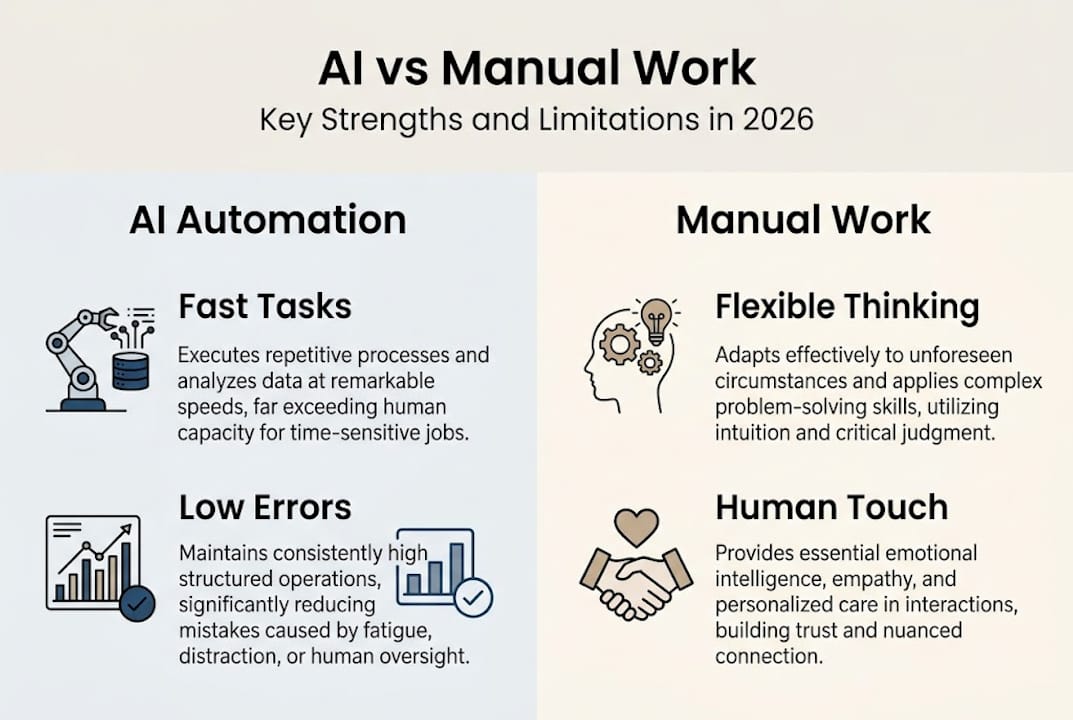
Hybrid strategies consistently outperform either pure automation or fully manual operations. The logic is straightforward: AI excels at speed, scale, and pattern recognition. Humans excel at judgment, creativity, and relationship-building. A system that combines both is more capable than either alone.
A practical hybrid framework looks like this:
- Automate the baseline. Use rule-based systems to handle the predictable, structured parts of any workflow: data capture, routing, scheduling, and notifications.
- Layer in AI for adaptability. Deploy AI where inputs vary and where learning over time creates compounding value, such as in customer support triage, content personalization, or demand forecasting.
- Preserve human judgment at key touchpoints. Identify the moments in each workflow that directly affect customer trust or carry significant business risk. Keep humans accountable at those points, even if everything upstream is automated.
- Build feedback loops. Capture data on where AI recommendations are overridden or corrected. This is valuable training signal that improves future performance.
Common pitfalls to avoid include over-replacement (removing humans from processes before AI is proven), under-validation (trusting AI outputs without a review layer), and neglecting change management (failing to bring your team along on the transition). For a practical look at how this plays out in customer-facing contexts, AI for customer engagement offers concrete examples from SMB deployments.
Pro Tip: Schedule a quarterly workflow review to rebalance human and AI responsibilities. As your team’s skills grow and your AI systems accumulate more data, the optimal division of labor will shift. Treat it as a living system, not a one-time configuration.
Our take: What most guides miss about AI vs manual work
Most articles about AI automation focus on what to automate. The harder and more important question is what not to automate.
At SimplyAI, we have seen businesses rush toward full automation and encounter a predictable problem: the processes they automated were the ones that still needed human judgment at their core. Customer onboarding that felt robotic. Support responses that lacked context. Decisions made by algorithm that should have involved a person. The technology worked. The outcome did not.
The real differentiator between businesses that succeed with AI and those that struggle is not the sophistication of the tools. It is the clarity of thinking about process ownership. Automation should free your people to do more of what only they can do, not replace the human moments that actually build your brand.
The enterprise AI transformation conversation in 2026 is moving from “how do we automate?” to “how do we continuously improve?” That shift in framing changes everything. It turns AI from a cost-cutting exercise into a growth engine, and it keeps humans central to the strategy rather than marginal to it.
Get started with AI automation for your business
Understanding the theory is valuable. Acting on it is what separates growing businesses from those that stall. If you are ready to move from evaluation to implementation, SimplyAI designs and deploys practical AI solutions built specifically for small and medium-sized businesses.
Whether you need AI automation services to streamline repetitive workflows or AI agent solutions that handle dynamic customer interactions, SimplyAI builds systems tailored to your operations, not generic templates. Every engagement starts with understanding your specific processes, identifying the highest-impact opportunities, and delivering measurable results. Reach out today to schedule a consultation and find out exactly where AI can move the needle for your business.
Frequently asked questions
What are the main differences between rule-based automation and AI automation?
Rule-based automation uses fixed if-then logic and works well for structured, predictable tasks. AI relies on ML and pattern recognition, allowing it to handle unstructured inputs and adapt over time.
Does AI automation always increase productivity?
Not automatically. While AI tools can boost task completion rates significantly, verification and oversight needs can offset those gains if implementation is poorly planned.
When should manual work be prioritized over automation?
Manual work should lead whenever a task requires empathy, nuanced judgment, or creative problem-solving. Manual outperforms automation in EPOCH skills, which remain the domain of skilled humans.
Is a hybrid approach better than choosing only AI or manual work?
For most SMBs, yes. Hybrid strategies yield the best outcomes by combining automation where consistency and speed matter with human oversight where judgment and relationships are on the line.